Made-to-Measure Pivot Glass Door — The Most Elegant Movement of All
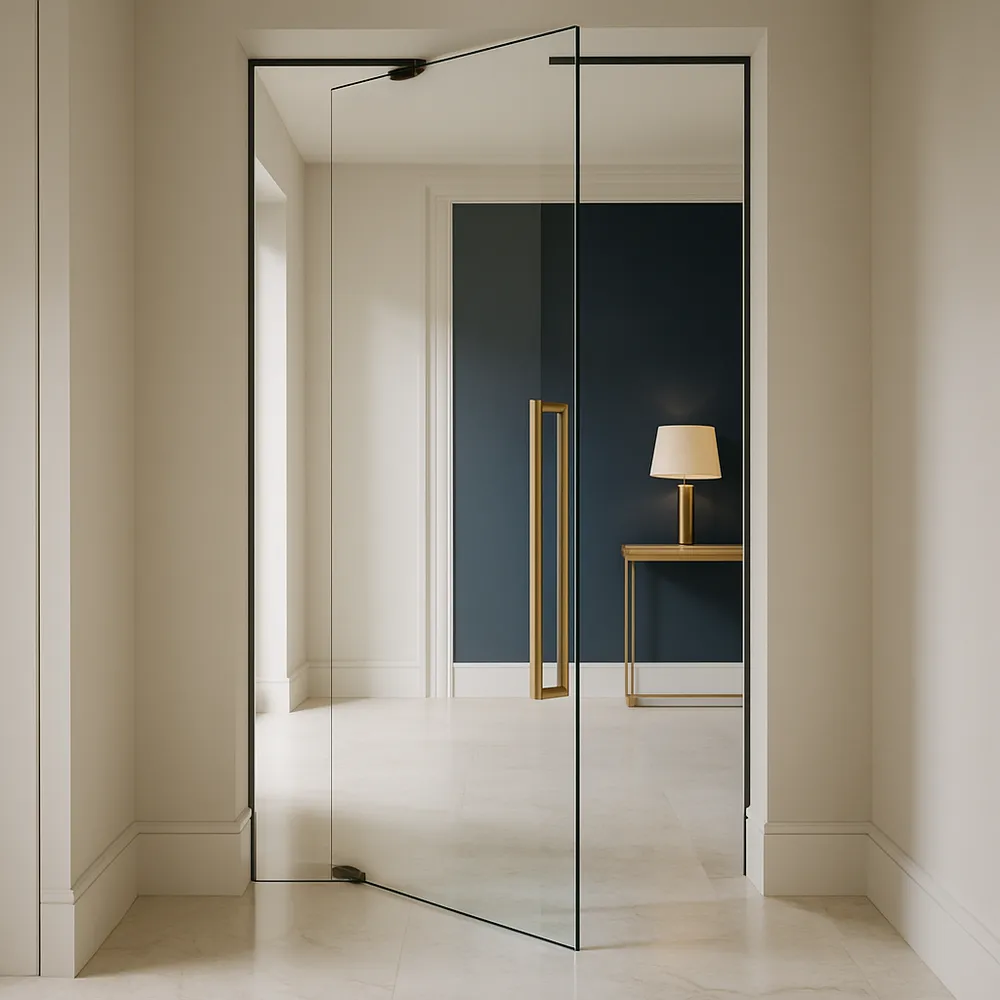
A pivot door turns on a vertical axis, central or offset, and moves with a generous, silent sweep no other door can match. It is the design piece architects choose for spaces where every detail has something to say.
When coming in becomes a ritual
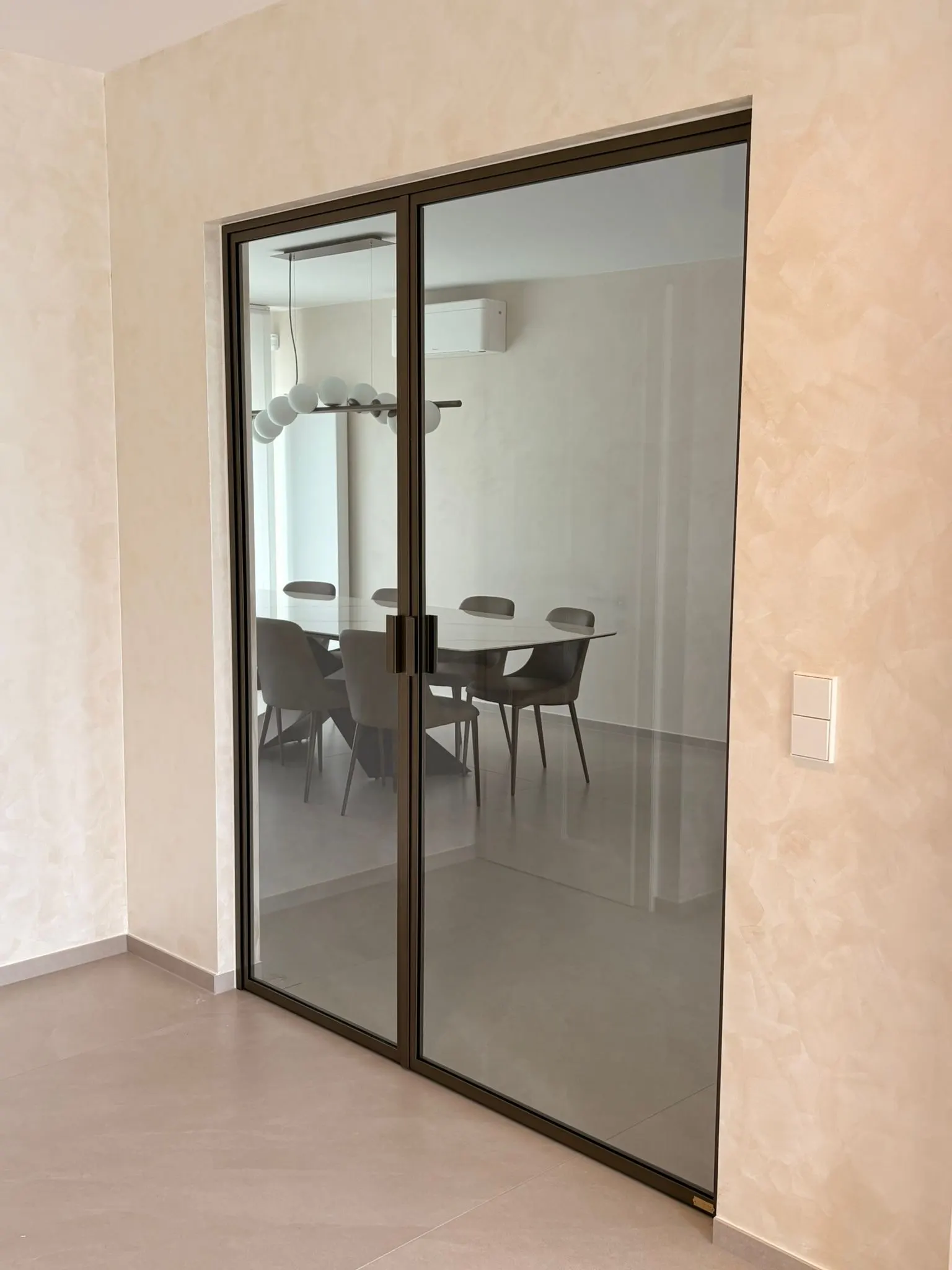
A pivot door is not simply a door: it is an experience. Its movement — generous, fluid, silent — is quite unlike that of a conventional hinged door. The reason lies in the pivot system: the axis of rotation is not at the edge of the door but within its face, set back by a distance that depends on the configuration. The door seems to float around its axis, as if it were suspended in mid-air.
Vitralux makes pivot glass doors to measure in Luxembourg, in any size you want. The system rests on a floor-mounted door closer: a high-precision mechanical component that keeps the movement even, cushions the door at the end of its travel and holds it shut. The closer sits in the floor and is all but invisible: only the top and bottom pivots are on show, discreet and elegant.
The pivot glass door suits contemporary houses, high-end entrance halls, prestige flats and commercial spaces where the architecture takes every detail seriously. It takes any glass in the Vitralux range, and the ironmongery and pivots come in stainless, gold or matt black PVD.
Central or offset pivot: what is the difference?
Offset pivot (the most common)
The axis of rotation sits about 10 to 15 cm in from the edge of the door. The door opens mainly to one side, with a slight counterbalance to the other. The movement is fluid and natural, much like a conventional door but with a wider sweep and more elegance.
Central pivot (a symmetrical effect)
The axis sits at the exact centre of the door. It opens symmetrically both ways — push it and it swings left and right at the same time. A spectacular, architectural effect. It needs clear space on both sides of the door.
Topivot (floor-to-ceiling pivot)
A variant of the offset pivot in which the pivots are set into the floor and the ceiling at once, with no side post at all. The result is absolutely clean: the door seems to float between two planes. The premium solution for prestige halls and ambitious architectural projects.
Floor-mounted door closer
Whichever pivot configuration you choose, the closer sits in the floor. It gives a soft, quiet close, cushions the door at the end of its travel and holds it shut without effort. Vitralux uses closers from the leading European makes.
Which glass for your pivot door?
Parsol tinted
Bronze, grey, green, blue, black. Partial privacy, softened light. Ideal for private entrance doors and office doors.
Satinato sandblasted
Translucent: diffused light without a direct view through. Ideal for rooms where you want visual privacy.
Decochrome mirrored / gold
A luxurious metallic coating from the Arcon Decochrome range — a mirrored or gold effect, for prestige projects.
Laminated glass with a decorative interlayer
A solid colour, a gradient or a pattern set between the two panes of glass. Safety and a look of your own in one.
Digital printing
A design printed before toughening — permanent: a photograph, a texture, a logo or a geometric pattern.
Laser engraving
A frosted design engraved into the glass — precise to the millimetre, elegant in effect.
Three finishes to make your pivot door your own
Stainless / brushed steel
The most timeless and the most versatile finish. Pivots, closer and handle in brushed stainless steel. Maximum durability, minimum upkeep.
Gold / brushed brass
The premium finish, very much of the moment in luxury contemporary interiors and in hotels. Gold pivots and handle, coordinated with the other fittings in the room.
Matt black PVD
An extremely hard-wearing PVD coating that resists fingerprints, decidedly contemporary in effect. The finish of choice for minimalist interiors and for doors in black Parsol.
The Vitralux pivot door — technical specifications
| Opening system | Pivoting — central or offset axis |
|---|---|
| Door closer | Set into the floor — soft, quiet close |
| Standard glass thickness | 10 mm toughened — or 8+8 mm toughened laminated |
| Glass available | Parsol · Satinato · Decochrome · Laminated with a decorative interlayer · Digital printing · Laser engraving |
| Ironmongery finishes | Stainless · Gold · Matt black PVD |
| Format | Made to measure — any size, subject to a survey of the configuration |
| Applications | Entrance hall · Living room · Office · Hotel · Showroom |
| Installation | By Vitralux technicians — coordinated with the tiler for the floor closer |
Data sheets as PDFs
Download the pivot door data sheet and the brochure for Arcon Decochrome mirrored and gold glass.
One of the most technical things we make
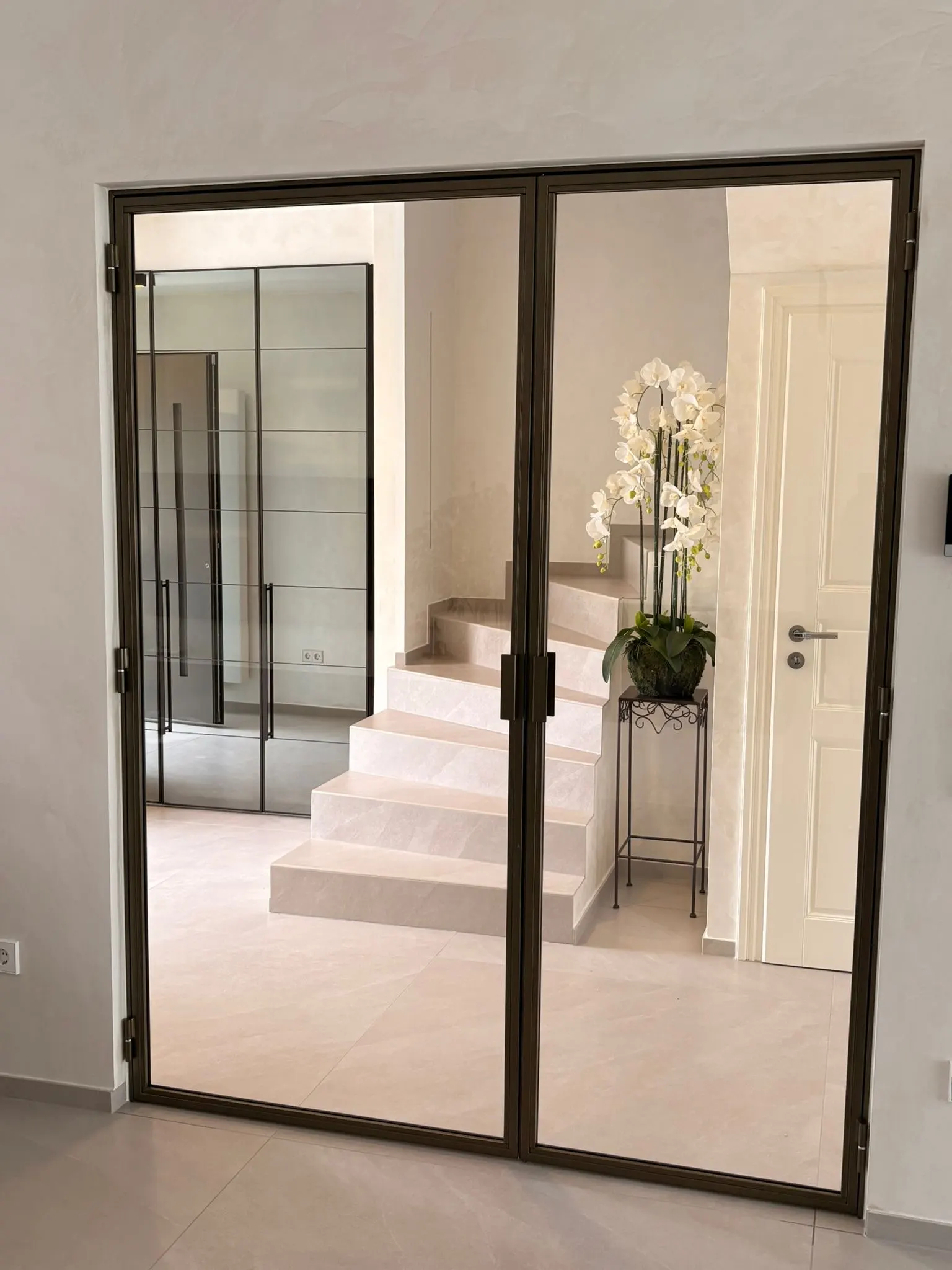
The pivot door is one of the most technical products Vitralux offers. It has to be installed to within a millimetre: the floor closer must line up exactly with the top pivot, the floor must be perfectly level, and the glass must be made to the exact size of the opening with no play at all. That is why Vitralux always coordinates the installation with the tiler and the architect.
Come and see the pivot configurations at our Howald showroom, and handle the glass and finish samples. Every pivot door is one of a kind: we design it to measure for your particular project.
Your questions about the pivot glass door
A conventional hinged door turns on an axis at its edge: the movement always goes one way. A pivot door turns on an axis within its face (offset or central): the movement is wider and more fluid, and the axis can sit anywhere across the width of the door. A pivot needs a closer set into the floor, whereas a hinge is fixed to the frame or to the wall.
Yes, absolutely. The closer sits in a recess cut into the floor before the tiles go down. If the tiling is already laid, some of it has to come up. Vitralux gives you the exact specifications when you order: it is essential to involve the tiler from the design stage.
Yes, but it needs particular care. The recess for the floor closer must not cut through the heating circuits. Vitralux agrees the technical details with the heating engineer and the tiler so that the installation works. That coordination belongs in the design stage.
The quality closers Vitralux uses are set up for a gradual, quiet close. The closing speed and the cushioning at the end of the travel are both adjustable. Once the door is in, our technicians make the fine adjustments in front of you until it behaves exactly as you want.
Yes. The pivot systems and closers Vitralux uses are professional components tested over tens of thousands of cycles. They are used in hotels, offices and busy public spaces. In a home, they will comfortably last the life of the house with minimal upkeep.
Our pivot glass doors
Your pivot glass door, made to measure in Luxembourg
Come and see the pivot configurations at the Howald showroom, or request a free quote with a survey visit included.
Also worth a look: Glass partitions · Glass balustrades · Shower screens