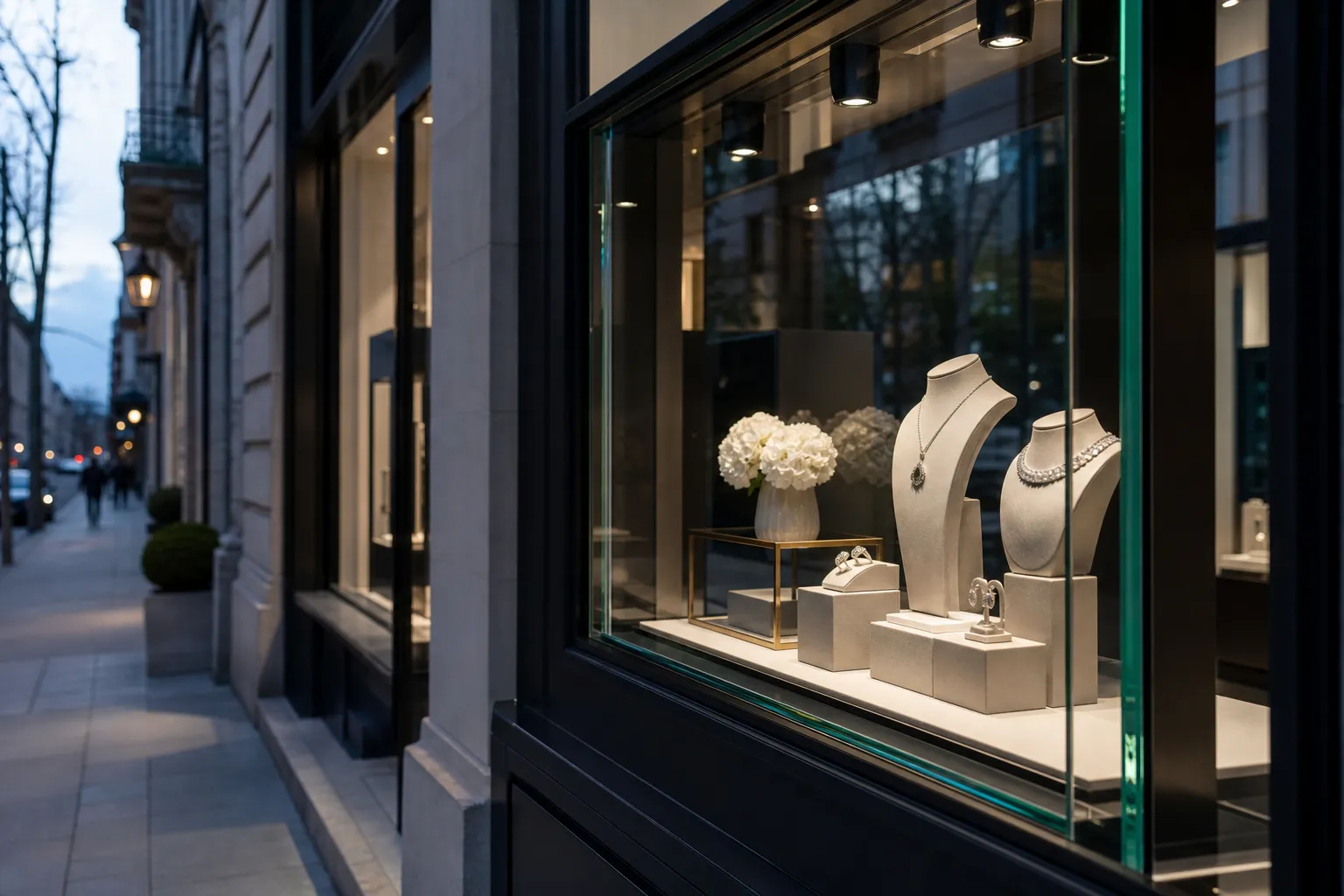
Security Glass and Panzerglas in Luxembourg — Supply, Installation and Replacement
Security glass — also known as Panzerglas, or delay-rated safety glazing — is the first physical line of defence a shop or an institution has against intruders. Vitralux supplies, fits and replaces certified security glazing in Luxembourg for jewellers, banks, late-night pharmacies, bureaux de change, embassies and any business that needs a high level of protection.
Security glass does not stop a break-in: it delays it.
The certified resistance — from a few minutes to several dozen blows depending on the class — buys the time the security services need to arrive. It is this principle of delay that EN 356 assesses and certifies.
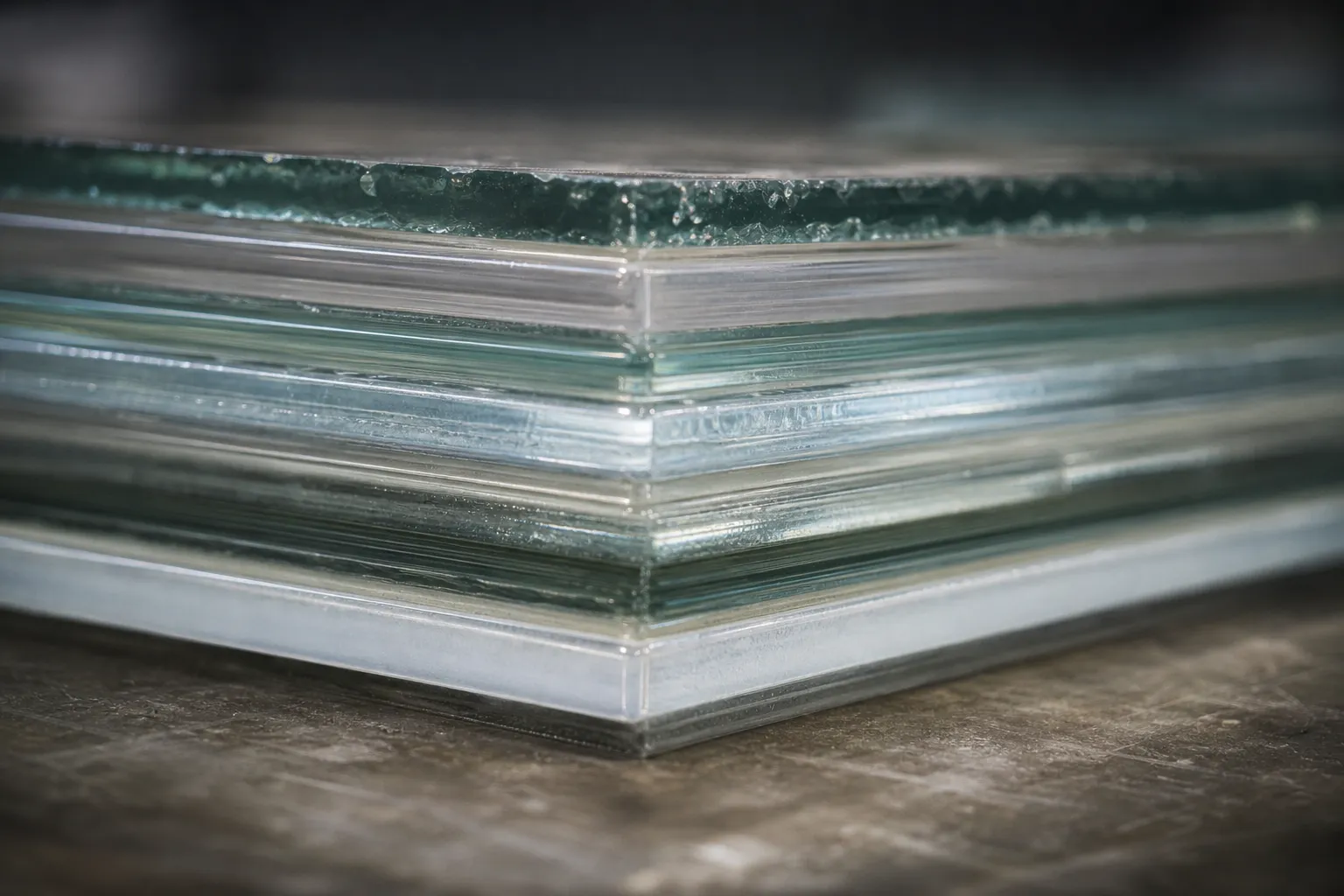
How security glass works: a multi-ply laminate absorbs the blows
Security glass is always laminated glass: several sheets of glass bonded together by polymer interlayers (PVB, SGP or polyurethane) of varying thickness and make-up. Under a blow or an attempted break-in the glass cracks but stays in place: the interlayers hold every fragment together and the surface remains a physical barrier. The higher the class, the greater the total thickness and the longer the glass holds out.
Traditional Panzerglas is a laminate of alternating glass and polycarbonate layers: the polycarbonate absorbs the energy of the blow and stops the tool getting through. This technology is used above all for bullet-resistant glazing in classes BR1 to BR7.
PVB laminated glass
A polyvinyl butyral interlayer: the usual solution for classes P1A to P5A. An excellent thickness-to-performance ratio. Very high optical clarity. Worked and fitted by Vitralux.
SGP / polycarbonate laminated glass
SentryGlas interlayers or polycarbonate layers: for the high classes P6B–P8B and for bullet resistance BR1–BR7. Maximum stiffness and energy absorption.
Which class of security glass does your business need?
Security glazing is classified and certified under strict European standards. The right class depends on the assessed level of threat, on what your insurer requires and on the advice of the police or your security provider. Vitralux guides you through that choice and supplies the certificates of conformity you need.
Security glass — EN 356
| Class | Certified resistance | Typical applications |
|---|---|---|
| P1A | Falling ball — 1 min 30, 10 impacts | Small shops, premium residential entrances |
| P2A | Falling ball — 3 min, 15 impacts | Small jewellers, pharmacies, offices |
| P3A | Falling ball — 5 min, 15 impacts | Jewellers, luxury retail, moderate-risk premises |
| P4A | Falling ball — 10 min, 15 impacts | High-end jewellers, bureaux de change, banks |
| P5A | Falling ball — 15 min, 15 impacts | Banks, luxury hotels, embassies, fine jewellers |
| P6B | Axe — 30 blows | Very high-risk targets, access to strongrooms |
| P7B | Axe — 51 blows | Maximum civilian security |
| P8B | Axe — 70 blows | Critical security — equivalent to armour |
Bullet-resistant glass — EN 1063 (Panzerglas)
| Class | Certified resistance | Typical applications |
|---|---|---|
| BR1 | 9 mm pistol | Jeweller and petrol station counters, supermarkets |
| BR2 | 9 mm pistol (3 shots) | Banks, bureaux de change, late-night pharmacies |
| BR3 | .357 Magnum revolver | High-security banks, casinos, embassies |
| BR4 | Winchester rifle | Gun shops, valuables depots |
| BR5 | Assault rifle | Government facilities |
| BR6 | Automatic weapon | Embassies, military posts |
| BR7 | Sniper rifle | Maximum civilian protection |
Which class is right for you?
Classes P1A to P5A are the ones Luxembourg retailers ask for most. BR1 and BR2 are common in banks and bureaux de change. Vitralux works through the level of protection that suits your premises and your insurer's requirements with you.
About the figures quoted
The resistance times, numbers of impacts and weapon types are the official definitions in EN 356 (security glass) and EN 1063 (bullet-resistant glass): they describe the class, not any particular product. The thicknesses, sizes and build-ups mentioned on this page are indicative and vary with the manufacturer, the product and the installation. They are not contractual: the exact characteristics of your glazing (class, thickness, size, tolerances) are set and confirmed during the survey on site and in the Vitralux quote, together with the manufacturer's certificates of conformity.
The Luxembourg businesses that need security glass
In certain kinds of premises, security glass is either required or strongly recommended in Luxembourg: insurers often make it a condition of cover for high-risk retail. Elsewhere it is a preventive decision taken by the operator or the owner of the building.
Jewellers & goldsmiths
Recommended class: P4A to P5A for the shopfront. Often required by the insurer. Shopfront panes, internal display cabinets, entrance doors.
Banks & financial institutions
Recommended class: P5A to BR2. Counters, strongrooms, customer entrances, façades. Bullet-resistant glazing is often required at the counters.
Late-night pharmacies
Recommended class: P3A to P4A. Shopfronts and secure entrances for pharmacies open at night and holding controlled drugs.
Bureaux de change
Recommended class: P4A to BR2. Transaction counters, secure entrance, shopfront panes.
Embassies & institutions
Recommended class: P5A to BR4 and above. Complete façades, entrance doors, windows. Security at diplomatic level.
Casinos & luxury retail
Recommended class: P4A to BR3. Secure entrances, cash desks, high-end display cabinets.
Vitralux supplies, fits and replaces any security glazing in Luxembourg
Vitralux takes on the whole glazing security project: survey of the site, choice of the right class, supply of the certified panes, removal of the old glazing, installation of the new and handover of the certificates of conformity. If an existing security pane breaks — an attempted break-in, an accident — Vitralux attends to replace it as an emergency.
Supply & cutting to measure
- Choice of the class certified to EN 356 or EN 1063.
- Cut to the exact size in our Howald workshop.
- Polished edges — thickness to suit the class.
- Large formats available depending on the class and the product.
- Certificates of conformity supplied with every delivery.
Installation & replacement
- Fitted on site by the Vitralux teams.
- Installation standards observed (framing, seals).
- Emergency replacement after an attempted break-in.
- Immediate temporary boarding-up where needed.
- Report on the work supplied for your insurer.
After a break-in: an absolute emergency
Replacing a security pane after a break-in or an attempted one is an absolute emergency for the safety of the premises. Vitralux attends quickly to make the opening safe, then replaces the glass permanently with a pane of the same class or higher — 24/7 emergency glazing or depannagevitres.lu.
Frequently asked questions about security glazing
The term "Panzerglas" (literally "armoured glass" in German) originally described laminated glass with polycarbonate interlayers used for protection against gunfire. Today it is used more loosely for any high-strength security glazing. Security glass covers classes P1A to P8B (EN 356), while bullet-resistant glass covers classes BR1 to BR7 (EN 1063). Vitralux supplies both families.
Yes. Every security pane supplied by Vitralux comes with its certificate of conformity for the certified class (EN 356 or EN 1063). You need that document for your insurance file. We can also supply the manufacturer's technical data sheets for any glazing you order.
Not always. Security glass is a good deal thicker than standard glazing, and the thickness rises with the class and varies with the product and the manufacturer. The existing frame has to suit that thickness. Vitralux assesses your premises on site and tells you whether the frame needs adapting before we price the replacement.
A P4A pane is certified to withstand 15 falling-ball impacts over 10 minutes under standardised test conditions. In a real attack, with different tools or angles, that time can vary. The aim is not to be indestructible: it is to delay the intruder long enough for an alarm and a security response to happen.
Yes. Security glazing in classes P1A to P5A is optically very close to standard glass: from outside, the difference is barely noticeable. Only the greater thickness may show at the edges or in the frame. For jewellers and luxury retailers, keeping the look unchanged is exactly what matters.
Yes. Vitralux makes the opening safe straight away (a rigid panel or a security film), then replaces the glass permanently with a pane of the same class or higher, as quickly as possible. You receive a report on the work for your insurer. For emergencies: (+352) 621 817 650 or depannagevitres.lu.
Other security glazing from Vitralux

Your security glazing project in Luxembourg
Classes P1A to P8B • Bullet-resistant BR1–BR7 • CE certificates • Jewellers, banks, embassies
See also: glass repair — every kind of glazing · shopfronts