Two-Way and Semi-Reflective Mirrors in Luxembourg — MIRASTAR®, Supplied, Fitted and Replaced
The two-way mirror — also called a half-silvered or semi-reflective mirror — is a pane with two jobs: a mirror in the brightly lit room, and a see-through pane from the other side. Vitralux supplies and fits made-to-measure two-way mirrors in Luxembourg, chiefly MIRASTAR® by Saint-Gobain Glass, and replaces any existing two-way mirror wherever that can be done.
One pane, two jobs
Vitralux supplies and fits made-to-measure two-way mirrors in Luxembourg, chiefly MIRASTAR® by Saint-Gobain Glass, and replaces any existing two-way mirror wherever that can be done.
The two-way mirror works on a simple principle: wherever the light is strongest, the glass reflects like a mirror. In the darker room on the other side, the glass is see-through. It is the difference in light levels that creates the effect.
How the two-way mirror works: the difference in light does it all
The two-way mirror is a high-reflection coated glass: a layer of metal oxides deposited by magnetron sputtering onto clear float glass gives it a light reflectance of 55% to 59% and a light transmittance of 3%. That imbalance creates the effect.
Mirror effect
Reflectance (55–59%) wins — the surface reads as opaque and reflective. In the brightly lit room, the glass looks like a mirror.
A clear view through
The 3% transmittance is enough to see through without being seen from the other side. In the dark room, the glass behaves like a window.
Lighting is what decides it
The two-way mirror effect depends entirely on the difference in light levels between the two rooms. If both spaces are lit to the same level, the glass reads as a partly transparent mirror in both directions. Lighting design is therefore the make-or-break part of any two-way mirror project.
MIRASTAR® by Saint-Gobain Glass — the benchmark two-way mirror
Vitralux works chiefly with MIRASTAR® by Saint-Gobain Glass, one of the benchmark two-way mirrors on the European market: metal oxides deposited by magnetron sputtering onto clear PLANICLEAR® float glass. A certified industrial technology that guarantees stable optical performance, high resistance to moisture and long-term durability.
| Light transmittance | 3% — very low: all but opaque from the bright side |
|---|---|
| Reflectance, glass side | 55% — a very pronounced mirror effect in the lit room |
| Reflectance, coated side | 59% — maximum reflectance from the coated face |
| Thicknesses available | 4, 5, 6, 8 and 10 mm |
| Stock sheet size | 6,000 × 3,210 mm (PLF) — cut to measure by Vitralux |
| Conformity | Class A of the European standard EN 1096-1 (coated glass) |
| Certified testing | Resistance to abrasion · to acids · to condensation · to neutral salt spray |
| Can be toughened | Yes — MIRASTAR® can be toughened, worked and laminated to suit the safety requirement |
| Moisture resistance | Very high — installed in bathrooms, kitchens and coastal settings |
MIRASTAR® data sheet, Saint-Gobain Glass
Build-up, optical properties and handling of MIRASTAR® semi-reflective glass: download the full data sheet.
Where do you use a two-way mirror?
The two-way mirror answers a wide range of needs: security in retail, hotel and medical applications, and the most considered architectural interiors. Its versatility comes from its double nature: a mirror for one side, a window for the other.
Security & surveillance
Fitting rooms, sales floors: the two-way mirror allows discreet observation without customers noticing anything is there.
Luxury hotels
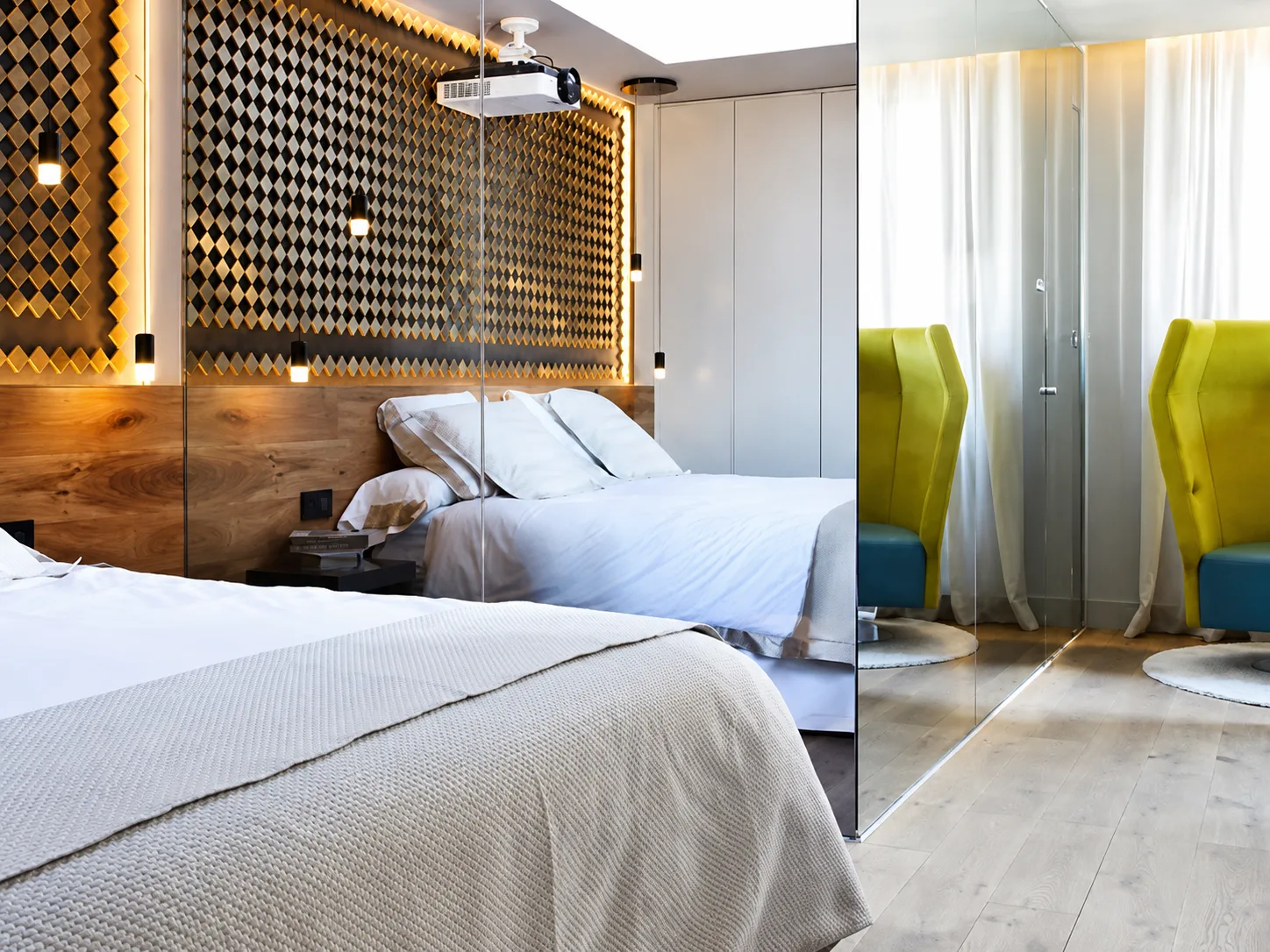
Between bathroom and bedroom: the two-way mirror draws a subtle visual line — a mirror from the lit bathroom, a window from the bedroom.
Medical & psychology practices
Observation and clinical teaching rooms: observation in one direction only, in strict compliance with medical and ethical protocols.
Architectural interiors
Mirror partitions between internal spaces: cuts of light, and a play of reflections and transparency that shifts with the daylight and the artificial lighting.
Splashbacks & wall cladding
MIRASTAR® can be backed with a film or a lacquer to create mirrored splashbacks: a kitchen or a bathroom with a reflection built in.
Furniture & appliances
Cabinet fronts, wardrobes and high-end appliances: MIRASTAR® also produces lighting effects when a light source sits behind it.
Vitralux supplies, fits and replaces any two-way mirror in Luxembourg
Vitralux takes on the whole two-way mirror project: from choosing the right glass for your situation through to the final fitting. The glass is cut to measure in our Howald workshop, and our teams fix it following the manufacturer's guidance: neutral-cure adhesives and tapes made for mirrors, with the coated face turned to the wall so the glass stays easy to clean.
Supply & cutting to measure
- The right glass chosen for the situation
- Cut to the exact dimensions in our workshop
- Polished edges — rounded corners if you want them
- Your choice of thickness: 4, 5, 6, 8 or 10 mm
- Can be toughened where safety calls for it
Fitting & replacement
- Installed on site by the Vitralux teams
- Neutral-cure adhesives and tapes made for mirrors
- Built to the safety standards in force
- Replacement of any existing two-way mirror wherever that can be done
- We work throughout the Grand Duchy of Luxembourg
Replacing an existing two-way mirror
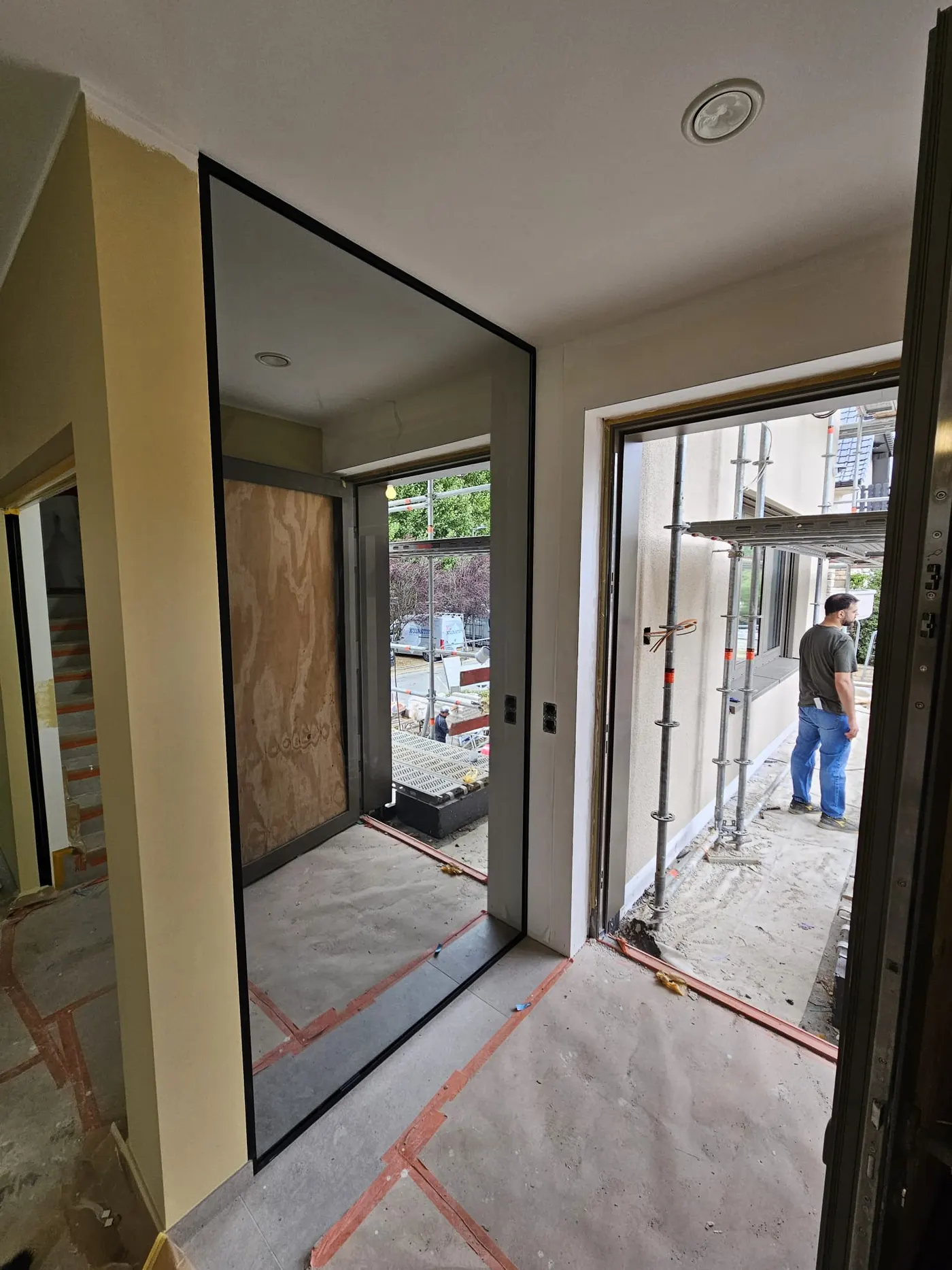
Replacing an existing two-way mirror is possible in the great majority of cases. Vitralux assesses the situation, measures the pane to be replaced and makes the new glass to the exact dimensions of the existing frame or fixing.
Frequently asked questions about two-way mirrors
They are two names for the same product. “Half-silvered mirror” historically describes a mirror whose opaque metal backing is absent or reduced, so that light passes through it. “Two-way mirror” describes the same technology but stresses its use for discreet observation. Today both terms describe high-reflection coated glass such as MIRASTAR®.
The effect depends entirely on the difference in light levels between the two spaces. If the observation space is much darker than the space being observed, it works perfectly. If both spaces are lit to the same level, the glass reads as partly transparent in both directions. Lighting design therefore has to be part of the brief from the start.
Yes. MIRASTAR® is extremely resistant to moisture: it is certified resistant to condensation and to neutral salt spray under EN 1096-1. It can be installed in bathrooms, in kitchens and even in coastal settings, using the right neutral-cure adhesives and tapes.
Standard two-way mirrors are made for internal use. For an external application, glass with additional treatments suited to the weather is needed. Vitralux looks at each specific enquiry and proposes the right technical solution.
In private spaces (a home, a hotel bathroom) installation raises no regulatory issue. In spaces open to the public, however, video or visual surveillance is governed by Luxembourg privacy legislation. Vitralux supplies and fits the glass only; making sure the use complies with the law is the client's responsibility.
The other types of mirror Vitralux offers
Clear or low-iron mirror, any size, polished edges. Bathrooms, interiors, hotels.
See the pageLaminated mirror (AGC Easy Safe) or with a safety backing film. For public spaces and buildings open to the public.
See the pageBronze, grey, green, blue, gold, rose… a distinctive touch for high-end interiors.
See the page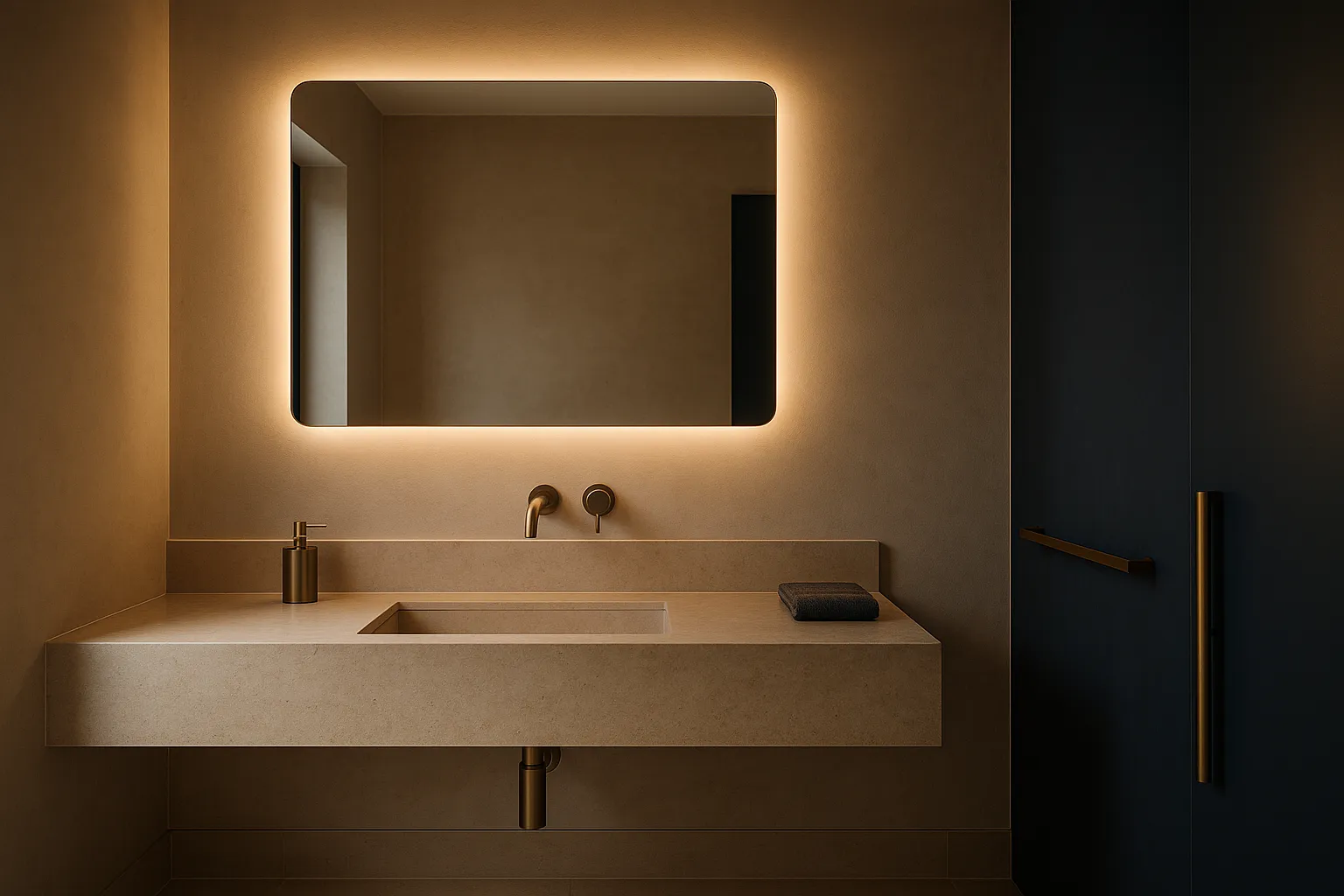
Your two-way mirror project in Luxembourg — free quotation
Saint-Gobain MIRASTAR® · Cut to measure in the workshop · Fitting and replacement · Anywhere in Luxembourg.