Made-to-Measure Accessible Mirrors — Accessible, Safe and Compliant
A mirror built for accessibility is more than a legal duty: it is a mark of respect towards disabled users. Vitralux designs made-to-measure accessible mirrors that bring compliance, safety and good looks together.
Requirements an ordinary mirror simply does not meet
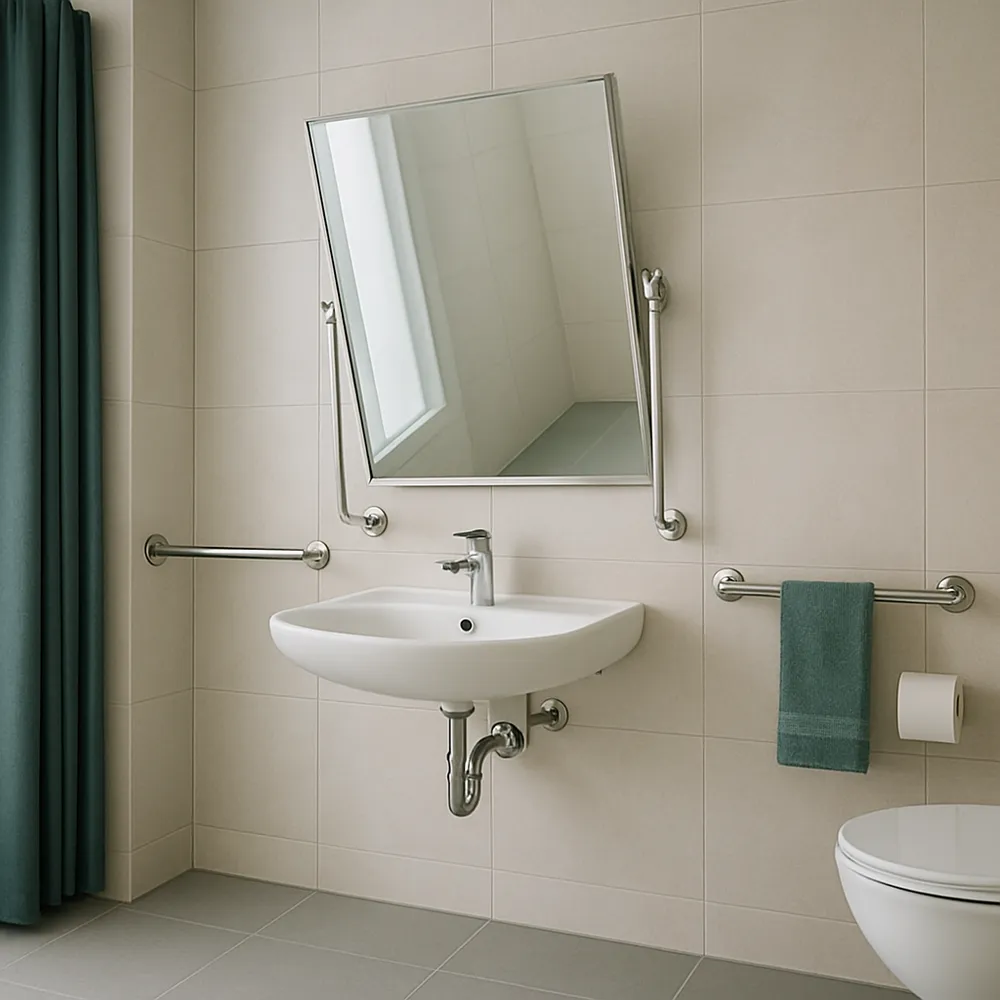
A mirror for someone with reduced mobility has to meet requirements an ordinary mirror does not. Its mounting height is set so that it can be used from a wheelchair. Its glass must be laminated safety glass, so that a breakage cannot cause injury. Some versions tilt, to improve the view depending on the nature of the disability.
Vitralux makes made-to-measure accessible mirrors in Luxembourg for every building covered by the accessibility rules: buildings open to the public, schools, hospitals, care homes, nursing homes, sports centres and swimming pools, hotels and shared accommodation. Our team knows the requirements inside out and supplies the technical information needed to bring accessible washrooms up to standard.
Every Vitralux accessible mirror is made in our Luxembourg workshop to your exact sizes, in laminated safety glass, and fitted by our technicians at the required height. We supply the technical documents where they are needed for sign-off by an approved inspection body.
What an accessible mirror has to get right
The points below are widely accepted guidance. Exactly what is required depends on the Luxembourg legislation that applies to the type of building.
Mounting height
The bottom edge of the mirror has to be usable from a wheelchair. The exact height is set by the accessibility rules that apply to the type of building — please confirm it with your approved inspection body.
The glass required
Laminated safety glass — EN 12600 or equivalent — is required in accessible spaces. If it breaks, the fragments stay bonded to the interlayer.
Tilting option
Some settings call for a mirror tilted downwards (by roughly 10° to 15°) to improve the view from a wheelchair. Vitralux offers that option.
Sizes
A minimum area is recommended by the rules in force. Vitralux makes every size to measure.
Secure fixing
The mirror has to be fixed firmly enough to take accidental sideways pressure. Our fixings are designed for exactly that.
Edges
Polished, rounded edges or a surround profile with no sharp arris — so that users cannot hurt themselves on contact.
Not sure what the rules require of you?
Exactly what is required (mounting heights, minimum sizes, certification) depends on the Luxembourg legislation that applies to the type of building. Vitralux does not give definitive regulatory advice: if in doubt, speak to your approved inspection body or your architect.
The Vitralux Accessible Mirror — specification
| Type of glass | Laminated safety glass — fragments held if it breaks |
|---|---|
| Tilting option | Available — a fixing system adjustable for tilt |
| Sizes | Made to measure — any dimensions |
| Edges | Polished and rounded, or a surround profile with no sharp arris |
| Fixing | Firmly anchored to the wall — resists sideways pressure |
| Technical documents | Supplied on request for sign-off by an approved inspection body |
| Applications | Public buildings · Schools · Hospitals · Care homes · Swimming pools · Hotels |
Accessible Mirror data sheet as a PDF
Glass build-up, safety certification and installation conditions that meet the accessibility rules: download the full data sheet.
Architects and building managers
Vitralux supplies the data sheets for the glass used (build-up, certification) for sign-off by the inspection bodies, and fits the mirrors with our own technicians. Let's talk about your project.
Frequently asked questions about the accessible mirror
The height of the bottom edge of the mirror is set by the accessibility rules that apply to the type of building and by the legislation in force in Luxembourg. It has to allow the mirror to be used from a wheelchair. If in doubt, speak to your approved inspection body or your architect: Vitralux then fits the mirror at the height set for your project.
Yes. In accessible spaces open to the public, laminated safety glass is a standard requirement: if the mirror breaks, the fragments stay bonded to the interlayer instead of flying across the room. Someone in a wheelchair, or with reduced mobility, is particularly exposed to flying glass. EN 12600 or an equivalent standard generally applies.
A tilting mirror has a fixing system that lets the mirror be angled 10 to 15 degrees downwards. That improves the view for wheelchair users who cannot get close enough to the wall. It is the answer we recommend where space in front of the basin is tight, or where the rules for the building call for it.
Yes. Vitralux supplies the data sheets for the glass used (build-up, certification) on request. Those documents can be put before the approved inspection body as part of bringing a building up to standard. Do tell us you need them when you place the order, so that we can have them ready in good time.
Other types of mirror worth a look
Laminated glass for public buildings and public spaces.
See the detail pageLarge-format laminated glass for sports studios.
See the detail pageThe made-to-measure classic.
See the detail pageFitting out a fully accessible washroom? Take a look as well at our step-free shower.
Your accessible mirror, compliant and fitted in Luxembourg
Vitralux knows the accessibility requirements and stays with you right through to sign-off.