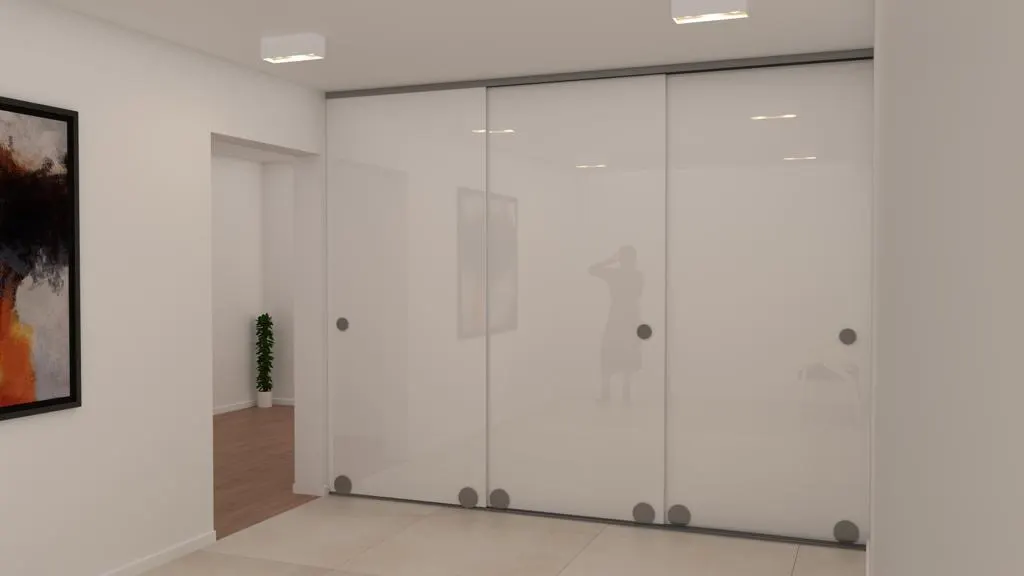
Made-to-Measure Sliding Glass Door — Four Systems, One Expertise
Nothing swings out, nothing gets in the way, and the door runs silently and smoothly: the sliding glass door is where technical precision and architectural looks finally agree. Vitralux offers four leading systems, chosen to suit the space, the use and how demanding the project is.
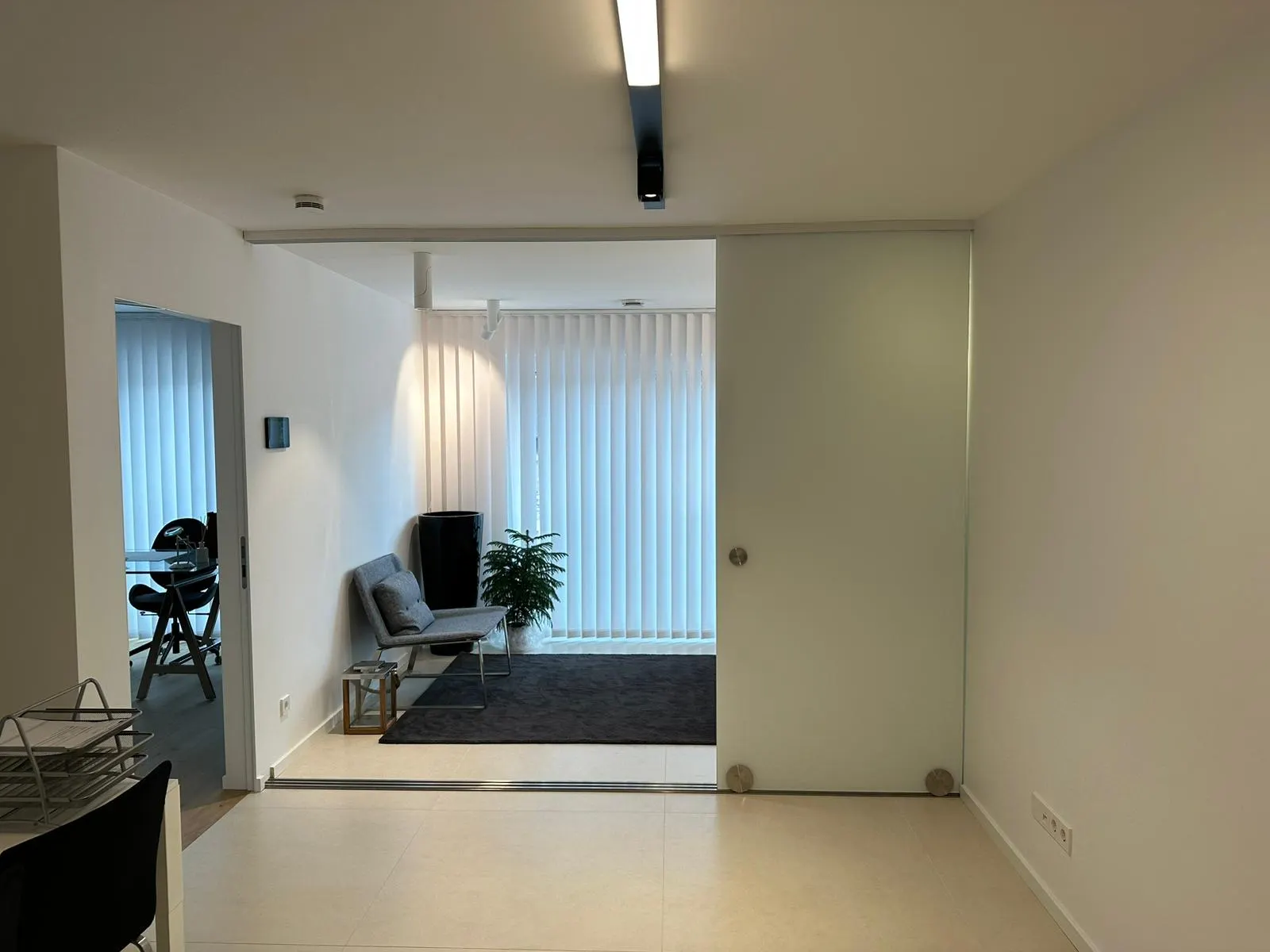
Space you get to keep
A hinged door takes up space when it opens. A sliding door takes up none: it travels along the wall, or disappears into it, depending on the configuration. That is a decisive advantage wherever every centimetre counts, and in open-plan spaces where the door has to get out of the way completely to let people move freely.
Vitralux fits made-to-measure sliding glass doors in Luxembourg using four leading systems: the Dorma Muto, a high-quality exposed system for homes and offices; the Dorma Manet, which sets into the wall or into a pocket; the Astec, an affordable but robust system for everyday use; and the MWE, the premium German system for the most demanding projects. Each one answers particular constraints and particular budgets.
Every one of these systems takes the six glass options in the Vitralux range (Parsol, Satinato, Decochrome, laminated with a decorative interlayer, digital printing, laser engraving) and comes in stainless, gold or matt black PVD. Vitralux technicians fit the door with the tools and the know-how each system calls for.
Which sliding system should you choose?
Each system suits a different setting and a different level of expectation. The comparison below and the detailed descriptions will point you in the right direction. Vitralux recommends the best system for you at the survey visit.
| Dorma Muto | Use: Home & office · Strength: Premium quality, silent running, discreet exposed track · Limitation: The system shows at the top of the door |
|---|---|
| Dorma Manet | Use: Refurbishment & new build · Strength: Sets into the wall, disappears completely · Limitation: Needs a pocket in the wall |
| Astec | Use: Everyday use · Strength: Excellent value for money, simple and robust · Limitation: A narrower range of finishes |
| MWE | Use: Premium projects · Strength: Top-end German system, premium finishes · Limitation: Costs more than the other systems |
Dorma Muto — the versatile benchmark
The Dorma Muto is the sliding system for glass doors used most in high-end homes and offices. Its track is exposed at the top of the door, but the design is so clean that it settles naturally into the space. The door runs quietly and is properly cushioned: the glass does not rattle, scrape or bounce. It is the system Vitralux fits most often.
- Track: exposed at the top, anodised or powder-coated aluminium profile
- Track finishes: silver, black or gold depending on the range chosen
- Running gear: high-precision, silent bearings
- Applications: private homes, offices, hotel suites
Dorma Manet — absolute discretion
The Dorma Manet is designed to disappear into the partition entirely. Its track sits in a pocket formed in the wall or in a stud partition: when the door is open it slides into the wall and is no longer visible at all. Only the handle stands slightly proud. It is the ideal system where the architecture wants the door to vanish completely on opening.
- Track: entirely concealed in the partition — nothing shows from outside
- Requires: a pocket or a stud partition formed for the purpose
- Planning: to be built in at the shell or partitioning stage
- Applications: design-led homes, high-end hotels, spaces where the door has to vanish
Astec — affordable strength
The Astec system is the choice where robustness and value for money matter more than premium finishes. Although it is less luxurious than the Dorma or MWE systems, it is reliable, long-lasting and perfectly suited to standard office doors, flat entrance screens and commercial premises.
- Track: exposed, robust, easy to look after
- Value for money: excellent for everyday use
- Applications: offices, shops, rented homes, standard partitions
MWE — German excellence
The MWE system is the premium benchmark for the most demanding projects. Made in Germany, it stands out for the quality of its finishes, the precision of its manufacture and how extraordinarily quietly it runs. Its end-of-travel dampers are the best on the market: the door slows and closes gently over the last few centimetres, with no impact at all. It is the system chosen for prestige homes, five-star hotel suites and spaces where every detail counts.
- Manufacture: German, superior quality and precision
- Dampers: soft close built in — the best on the market
- Finishes: the full range in stainless, gold and matt black PVD
- Applications: premium homes, 5-star hotels, showrooms, executive offices
Which glass for your sliding door?
Parsol tinted
Bronze, grey, green, blue, black. Partial privacy. Ideal for offices and entrances that want a degree of discretion.
Satinato sandblasted
Translucent. Diffused light without a direct view through. The most popular answer for bathroom and meeting room doors.
Decochrome
Mirrored or gold. Maximum prestige — the Arcon Decochrome range.
Decorative laminated glass
A coloured or printed film between two panes. Safety and a look of your own.
Digital printing
A permanent design printed before toughening. A logo, a texture, a photograph.
Laser engraving
A frosted design engraved into the glass. Elegant and understated.
The Vitralux sliding door — specifications
| Systems available | Dorma Muto · Dorma Manet · Astec · MWE |
|---|---|
| Exposed systems | Dorma Muto · Astec · MWE |
| Pocket system | Dorma Manet — track inside the wall |
| Glass thickness | 10 mm toughened as standard — 8+8 mm laminated on request |
| Glass | Parsol · Satinato · Decochrome · Laminated · Printed · Engraved |
| Ironmongery finishes | Stainless · Gold · Matt black PVD |
| End-of-travel dampers | Included on Dorma Muto and MWE — soft close |
| Format | Made to measure — any size, subject to a survey of the configuration |
| Applications | Homes · Offices · Hotels · Shops · Bathrooms |
Three finishes for tracks, carriages and handles
Stainless / brushed steel
The benchmark finish. It sits with every style. Long-lasting and easy to look after.
Gold / brushed brass
The luxurious finish for premium projects. Track, carriage and handle in matching gold.
Matt black PVD
Extremely hard-wearing, resists fingerprints. Ideal with black Parsol or Satinato glass for an all-black scheme.
Recessed finger pull in the glass edge
The elegant alternative to a handle that stands proud: a groove is milled straight into the edge of the glass with a profiled diamond wheel. The grip is built into the glass itself — no visible ironmongery, absolute minimalism. Made in the Vitralux workshop before toughening, and available on all our sliding doors.
Arcon Decochrome brochure (PDF)
Browse the full range of Arcon Decochrome mirrored and gold glass — colours, metallic effects and applications.
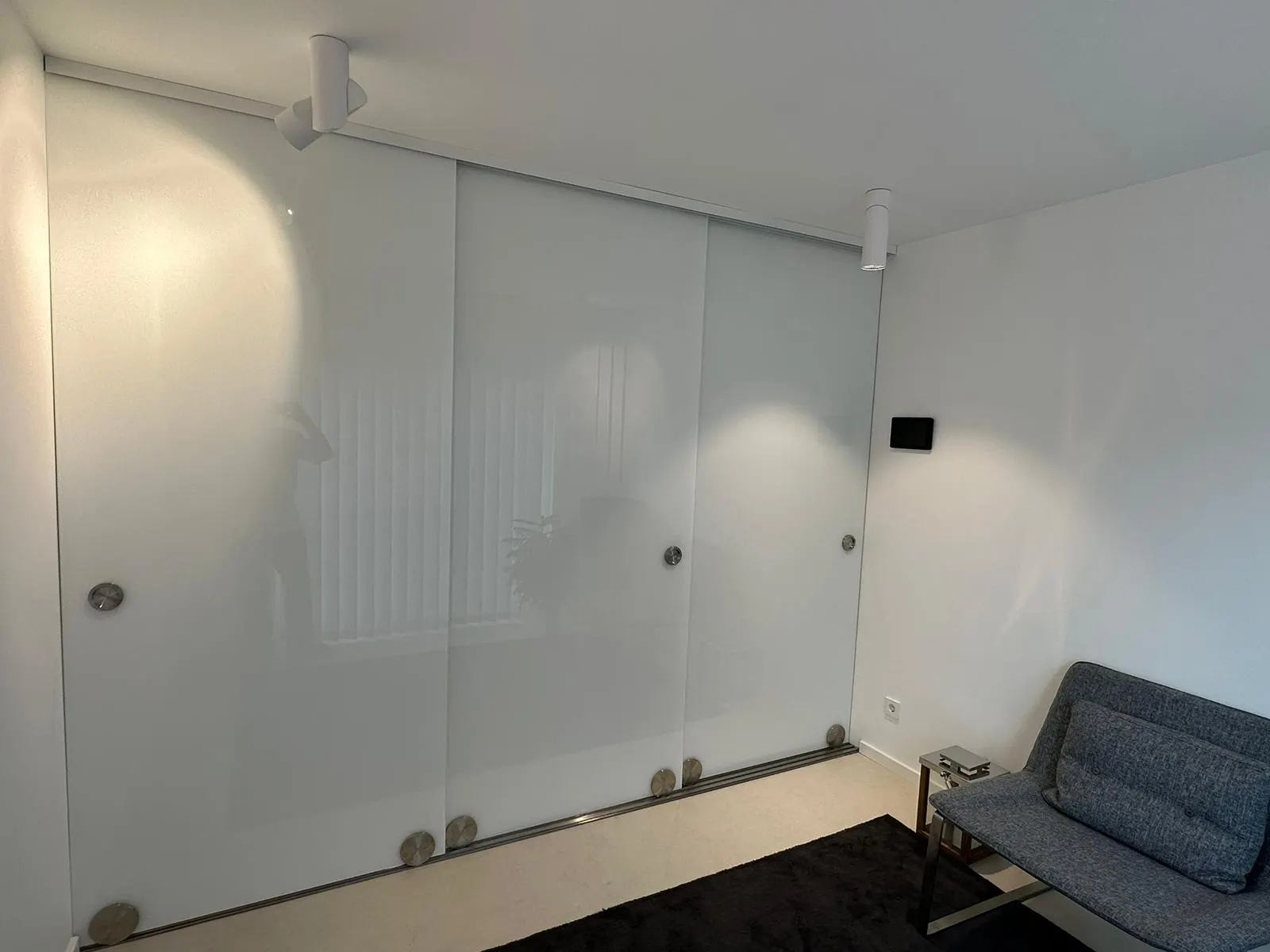
A perfect run, set up by our technicians
A single leaf across an opening, a pair of doors, or a full sliding screen that redraws the room: the Dorma, Astec and MWE systems cover every configuration. Once the door is in, our technicians set the travel, the alignment and the dampers in front of you until the run is perfectly silent.
Come and try the sliding systems in our Howald showroom and compare the stainless, gold and matt black PVD finishes. For a divider with no opening leaf, take a look at our made-to-measure glass divider.
Frequently asked questions about the sliding glass door
The Dorma Muto is an exposed system: its track is visible at the top of the door, fixed to the wall or the ceiling. It is the most common answer and the easiest to install. The Dorma Manet is a pocket system: its track is entirely hidden in a recess in the partition, so nothing shows when the door is open. The Manet needs the partition to be prepared for it in advance.
Yes, but it means partitioning work to form the pocket. In a plasterboard wall, a pocket the width of the door and of the necessary height has to be built. In a load-bearing wall, the feasibility has to be assessed with an architect or a structural engineer. Vitralux advises planning this system in at the construction stage or during a full refurbishment.
The MWE is one of the quietest sliding systems on the market. Its precision bearings and end-of-travel dampers make the run all but inaudible and the closing free of impact. That is the main argument for its higher cost on projects where the acoustic quality of the space really matters.
Yes — in a bathroom the sliding door is often the preferred configuration: it does not eat into the room when it opens and needs no clear space in front of it. Satinato glass is the one used most, to keep the room private. Stainless systems stand up to damp.
The finger pull is a groove milled straight into the edge of the glass with a profiled diamond wheel. It acts as a built-in handle: you slip your fingers into the recess and slide the door. No visible ironmongery, no handle standing proud — absolute minimalism. The pull is machined in the Vitralux workshop before toughening (it has to be done beforehand, because toughened glass can no longer be worked). Available on all our sliding doors, in a half-round or an elongated profile.
Other glass door configurations
Our sliding glass doors
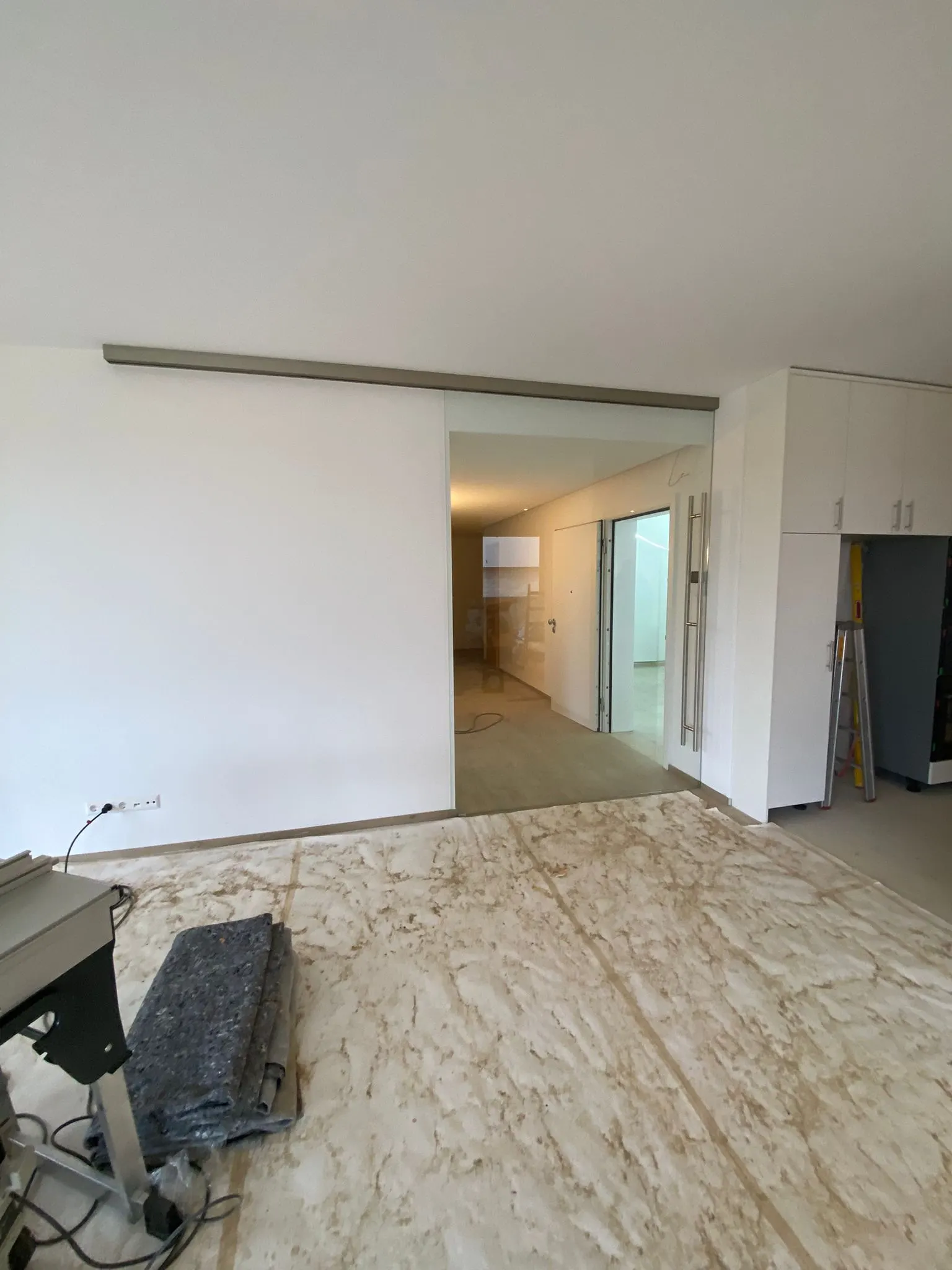
Your made-to-measure sliding glass door, fitted in Luxembourg
Come and see our sliding systems at the Howald showroom, or request a free quote with a survey visit included.
Also worth a look: Glass divider · Conservatories & Crittall screens · Shower screens